

Every day we see more children in consultations with sustained oral breathing, soft diets, open bites, and school problems. The relationship between adequate orofacial function, proper craniofacial development, and maximum cognitive development potential in children is close. VERY CLOSE.
Currently, between 38% and 81% of children present some form of orofacial dysfunction.
If we compare the figure with that of the 90s, 20% to 40%. we will understand the urgency of being, as dentists, better prepared in this regard
This significant increase in recent decades may be linked to factors such as the increase in respiratory allergies, prolonged pacifier use and thumb sucking, as well as a sedentary lifestyle and changes in eating habits.


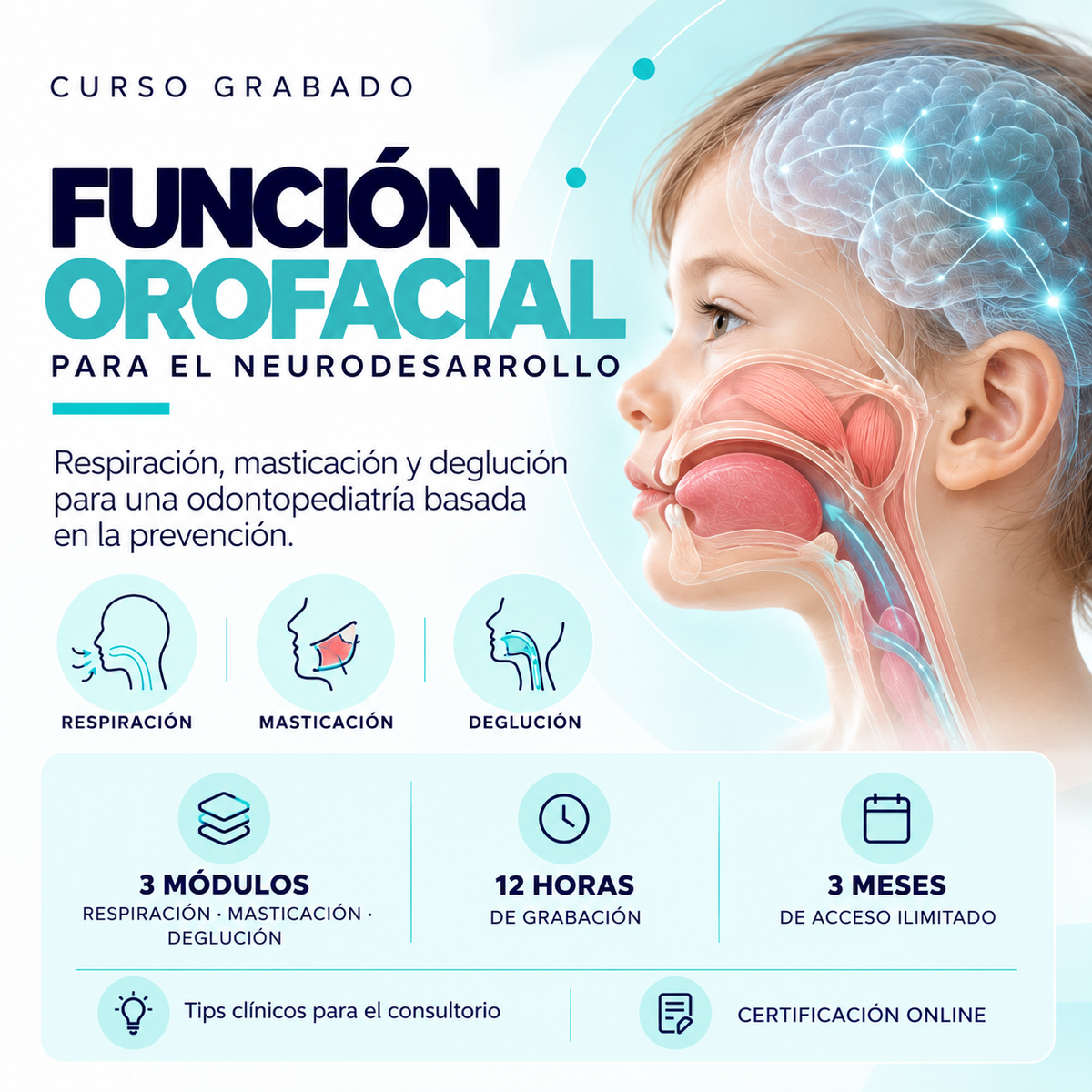
Orofacial Function for Neurodevelopment
Orofacial Function for Neurodevelopment
3 Modules: Breathing, Swallowing, and Chewing
12 Hours of Recording
Clinical Tips for the Practice
Certification
Couldn't load pickup availability


FIGURES THAT SET OFF ALARMS
-

Currently, around 55-60% of children with orofacial dysfunction show difficulties in school performance.
In the early 2000s, research estimated that only between 15-25% of children with orofacial dysfunction presented problems in school performance.
-

Approximately 30% of children with orofacial dysfunction report emotional and social problems
In the 1990s, studies in this field were limited, but it was estimated that only about 10-15% of children with orofacial dysfunction experienced social and emotional problems.
-

Currently, it is reported that 22-23% of children with orofacial functional disorders present anxiety disorders and behavioral problems
In the 2000s, studies suggested that only 5-10% of children with orofacial problems showed signs of emotional or behavioral disorders.


A COURSE THAT PUTS THE SOLUTION IN YOUR HANDS
Module 1: Breathing
In this module, we will understand the true importance of nasal breathing, both for maximizing brain functions and for future craniofacial development.
We will start from suckling during breastfeeding, move on to the topic of allergies, asthma, enlarged turbinates, and hypertrophic tonsils, and finally discuss sleep and the implications for it in the absence of 100% nasal breathing.
Module 2: Mastication
In this module, our journey begins in intrauterine life with the mother's diet and extends to the transition from breastfeeding to a soft diet and finally to a diet where masticatory processes are adequate.
We will discuss mirror neurons as a form of learning, food selectivity, and the consequences on language resulting from deficient chewing.
Module 3: Swallowing
This third module will address topics that affect correct swallowing, such as tongue position, frenula, and ogival palates. We will also address topics such as lip seal deficiency and the treatment options available to us. Finally, we will return to the topic of breastfeeding as the ultimate precursor to the correct development of orofacial function.

YOU WILL STUDY AT YOUR OWN PACE THROUGH A PLATFORM
SPECIALIZING IN ONLINE LEARNING
-

YOU DECIDE WHEN, HOW AND WHERE TO STUDY
You have 3 months of unlimited access to the course content, which you can pause, fast forward, or rewind, according to your needs
-

DO YOU HAVE A CONTACT LINE FOR YOUR QUESTIONS
You can always write to Dr. Claudia Restrepo Serna, to resolve your questions.
-

YOUR CERTIFICATION IS ONLINE
Once you complete your course, you can generate and download your certificate in PDF, which will include the hours of study and the date


Orofacial Function for Neurodevelopment